

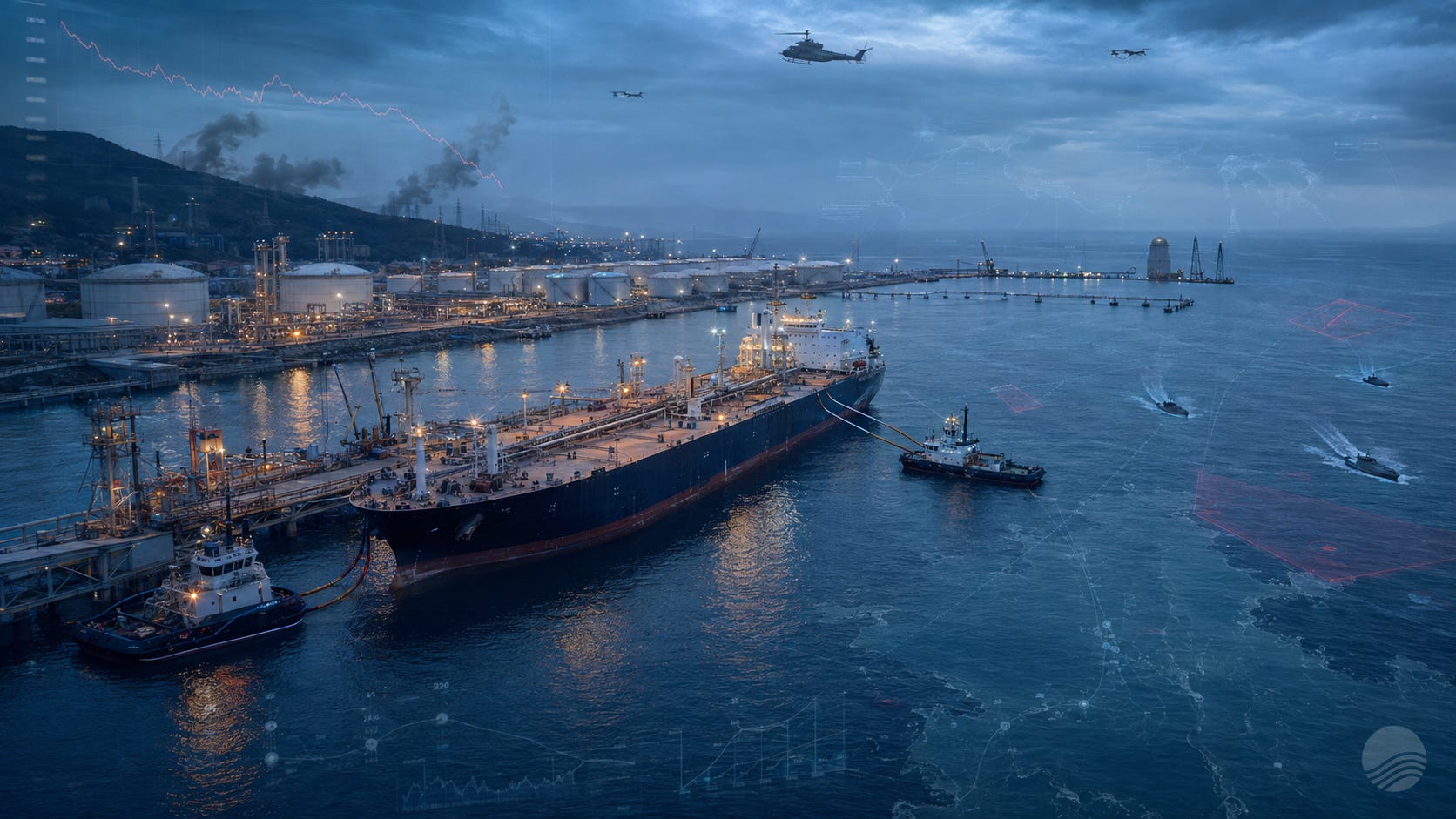
A second maritime chokepoint crisis is unfolding in parallel to Hormuz — and it’s arguably doing more direct damage to Russian export volumes.
BIMCO data shows dirty tanker loadings from Russian Black Sea and Sea of Azov ports fell 62% in the final two weeks of July, with Kazakh exports via the Caspian Pipeline Consortium (CPC) down by the same margin and shipments to India off 66%. If sustained, the disruption could shave 3% off global dirty tanker volumes in a market already softer year-on-year.
The mechanics of the disruption
The turning point came in mid-July, when four tankers loading Kazakh crude at the CPC terminal were struck by drones over four consecutive days. Bloomberg
The CPC route carries about 80% of Kazakhstan’s oil exports and more than 1% of global oil supply, moving crude from the Tengiz, Kashagan and Karachaganak fields via a 1,510-kilometer pipeline to Russia’s Black Sea coast. Major international producers — Chevron, ExxonMobil, KazMunayGas, Eni and Shell — rely on the route.
The strikes forced repeated shutdowns rather than a single stoppage. CPC confirmed the July attack was the fifth strike on its facilities, hitting tankers at two separate moorings.
Each closure forced Kazakhstan to throttle upstream output to avoid overfilling storage. Production fell to roughly 1 million barrels per day on one Sunday, down from an average 2.16 million bpd in June.
By late November, the damage escalated further. A Ukrainian naval drone strike significantly damaged a mooring at CPC’s Russian terminal, prompting Kazakhstan’s foreign ministry to publicly demand Ukraine halt attacks on what it called an exclusively civilian facility protected under international law.
The disruption spreads beyond one terminal
The impact then spread beyond CPC. Russia’s largest Black Sea oil facility, the Sheskharis terminal at Novorossiysk — which ships roughly 650,000 barrels a day on average — stopped loading crude entirely on July 21 amid the drone surge.
Novorossiysk also handles about a third of Russia’s grain exports, making it the country’s single most important grain hub — which is why the ripple effects extend well past crude into dry bulk and agri-trade.
Why owners are pricing in risk, not routing around it
Unlike a discrete single-incident disruption, this is a sustained campaign. Analysts note Ukraine doesn’t need to destroy every berth at Novorossiysk — repeated drone alerts and restrictions on ship movement are enough to make scheduled loading unreliable, which is itself what raises war-risk premiums and pushes owners to avoid Russian Black Sea ports altogether.
Kyiv has also begun targeting vessels tied to Russia’s shadow fleet specifically, which compounds the deterrent effect on tanker availability. Moscow’s own posture has hardened the risk picture further, with Russian authorities warning tankers that its Black Sea exclusive economic zone should be considered unsafe.
For Kazakhstan — a producer with no alternative sea route of comparable capacity — the exposure is structural rather than incidental. That’s what explains the increasingly public diplomatic pressure Astana has put on both Kyiv and Western partners to help secure the corridor, and it’s the clearest signal that CPC volumes are unlikely to stabilize on their own before the campaign itself changes course.