

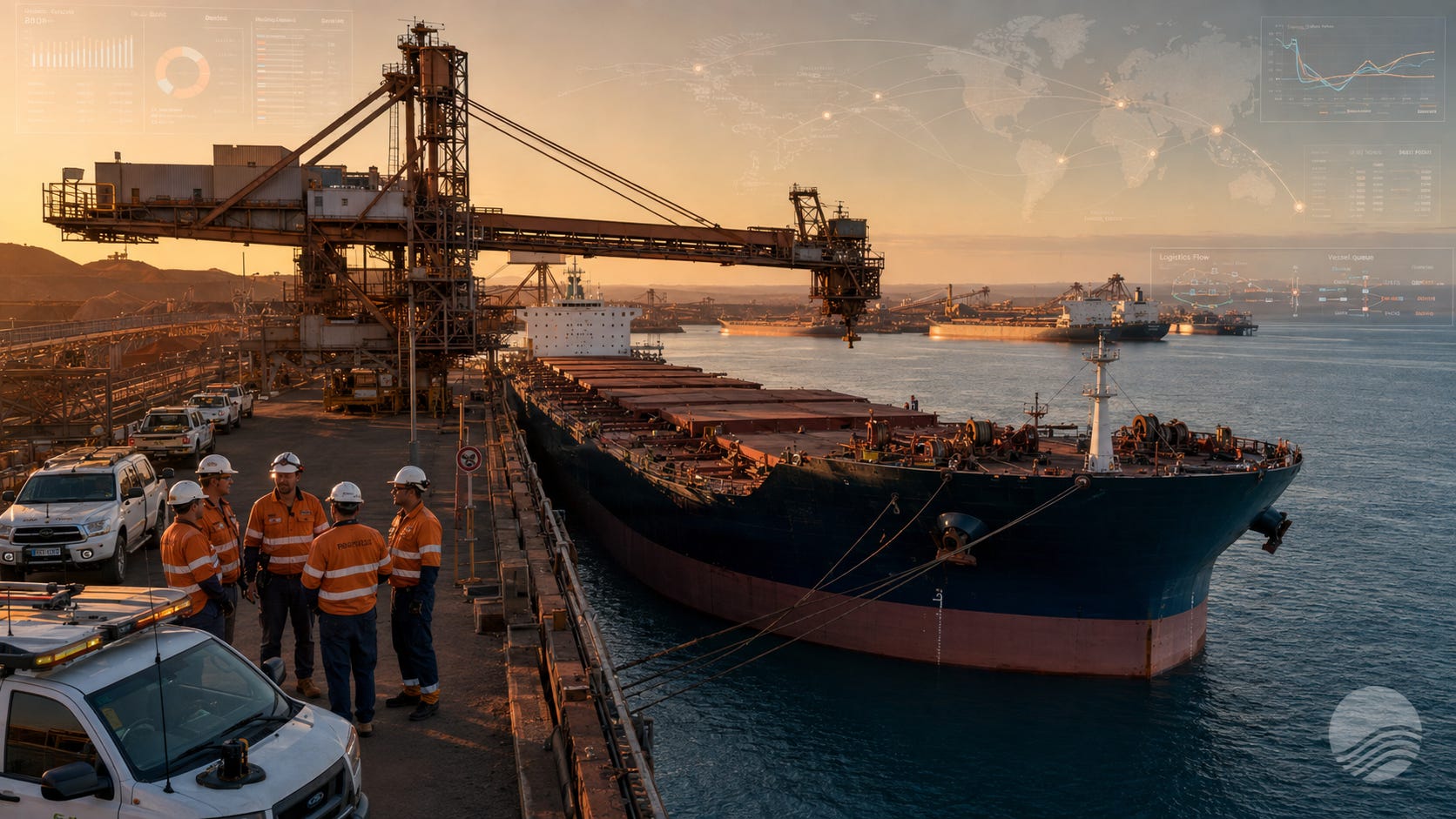
Unions at BHP’s Port Hedland terminal — the world’s largest bulk export port — have notified a 24-hour ship-loading ban starting August 8, escalating to a full work stoppage on August 9, unless bargaining resumes and succeeds before then.
The threatened action would directly hit iron ore shiploading at a facility that handles a substantial share of global seaborne iron ore supply, making even a short stoppage a market-moving event for steelmakers and traders tracking Australian export flows.
Capacity growth meets labor friction
The friction lands at an awkward moment for BHP. The company is in the middle of executing its Port Debottlenecking Project 2, a roughly $1.4 billion investment aimed at lifting Port Hedland’s throughput capacity.
A labor stoppage during this expansion phase underscores a tension increasingly visible across bulk export terminals globally: capital committed to capacity growth doesn’t always move in lockstep with labor relations on the ground.
Unions often use high-investment moments as leverage precisely because operators have the most to lose from downtime. For now, the dispute remains a bargaining-table standoff rather than a confirmed shutdown — both sides have an incentive to settle before August 8, given the cost of idling one of the world’s highest-volume bulk terminals even for a single day.
But the notification itself puts a hard date on the table, forcing BHP to either make meaningful concessions quickly or absorb a reputational and operational hit just as it asks stakeholders to back a near-$1.4bn capacity bet — with the first real test being how much iron ore volume moves, or doesn’t, in the 48 hours after August 8.