

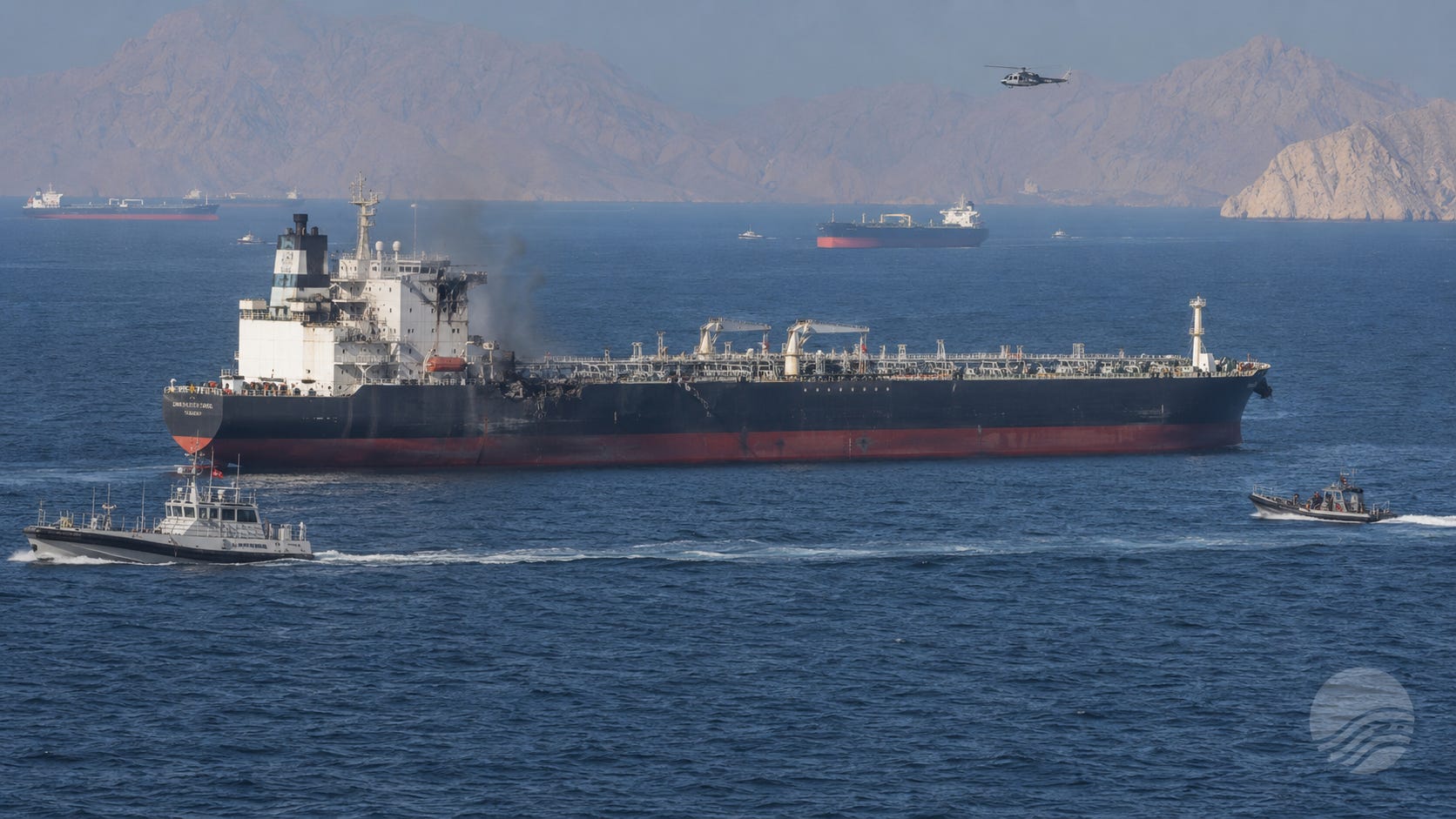
The United Arab Emirates has accused Iran of firing a missile at a tanker linked to the Abu Dhabi National Oil Company as it transited the Strait of Hormuz early Saturday. No injuries were reported, and ADNOC said the situation was brought under control, but the company confirmed it was the 16th attack on its vessels since the war began — including three in the past week alone.
The UAE Ministry of Foreign Affairs called the strike a “flagrant violation” of UN Security Council Resolution 2817, which affirms freedom of navigation and prohibits attacks on commercial shipping. Abu Dhabi went further, describing the strike as an act of piracy carried out by Iran’s Revolutionary Guard Corps, and demanded an unconditional reopening of the strait.
Condemnation followed swiftly across the Gulf. Qatar rejected any use of Hormuz as “a bargaining chip.” Kuwait called the attack a grave breach of international law. The Gulf Cooperation Council’s secretary-general labeled it a “dangerous and unacceptable escalation.” None of the statements identified who fired the missile beyond attributing responsibility to Iran, and ADNOC itself declined to name a party.
A strait that won’t stay closed — or open
The attack lands in the middle of a diplomatic tangle that has defined the Gulf conflict for months. Iran and Oman have reportedly made progress on an arrangement under which vessels would enter the Gulf via an Iranian-controlled corridor and exit through a route managed by Oman, with service fees attached for security and environmental upkeep. Washington has linked any such deal to lifting its naval blockade on Iranian ports, and US officials have previously warned that ceding effective control of the strait to Tehran would set a “dangerous precedent.”
Iran, for its part, is sending mixed signals. Its Revolutionary Guard has said the strait’s reopening hinges on the US “fully accepting Iran’s conditions” — including withdrawal of the naval blockade, war reparations, unfrozen assets and sanctions relief — and is explicitly not linked to the Oman talks. That leaves the diplomatic track and the technical route-management deal moving on separate, occasionally contradictory rails, even as fresh strikes continue on the water.
This is also not the UN’s first attempt to force the issue. A Bahrain-sponsored Security Council resolution to reopen Hormuz was vetoed by Russia and China back in April, despite eleven votes in favor. Resolution 2817, which Gulf states now invoke, followed later as a narrower measure — enough to record international disapproval, but with no enforcement mechanism that has stopped the attacks.
Why it matters for the market
Roughly a fifth of the world’s seaborne oil and LNG passes through Hormuz. Sixteen attacks on a single state oil company’s fleet — with three in one week — is the kind of frequency that keeps war-risk premiums and freight rates structurally elevated for any operator moving Gulf crude, regardless of flag or nationality. It also complicates underwriting for the wider tanker market, since insurers price risk across the strait as a whole rather than by individual owner.
The emerging Iran-Oman corridor arrangement, if finalized, would be the first concrete precedent for a paid, third-party-managed transit regime through a global chokepoint — a structure other littoral states, from the Bab-el-Mandeb to the Bosphorus, could eventually look to replicate. Whether that materializes in the next two weeks, before the interim truce window Iran and Oman set in June runs out, is likely to matter more for freight economics than any single strike.