

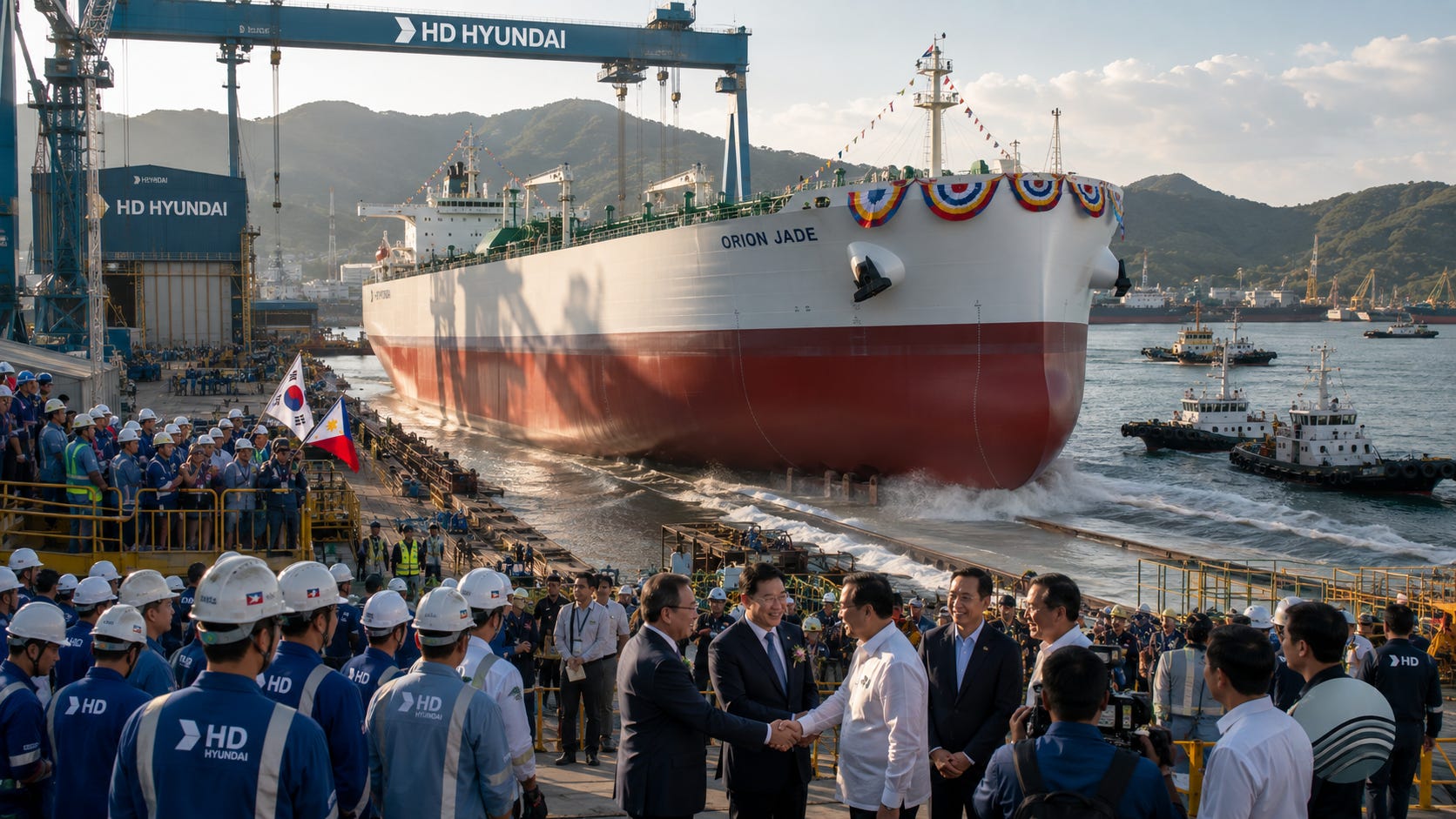
HD Hyundai Heavy Industries Philippines has launched the Orion Jade, a 250-metre petrochemical tanker and the first newbuild completed at the former Hanjin shipyard in Subic Bay since the yard’s operator collapsed in 2019.
The launch is more symbolic marker than isolated transaction — it signals the full-scale resumption of large-scale commercial shipbuilding in the Philippines under HD Hyundai’s roughly $550 million, 10-year investment plan for the site.
A yard with a difficult history
The yard’s history makes the moment notable. Hanjin’s 2019 collapse was, at the time, one of the largest corporate bankruptcies in Philippine history and left a hole in the country’s industrial shipbuilding capacity that took years to attract a serious replacement operator.
Where Subic Bay fits in HD Hyundai’s global strategy
The Orion Jade fits into HD Hyundai’s broader two-track approach to global shipbuilding capacity: high-value, complex vessels — LNG carriers, specialized tankers, naval and offshore units — built in Korea, while lower-cost, higher-volume tonnage shifts to Southeast Asian yards where labor and land costs are more competitive.
Subic Bay’s revival positions it as the anchor of that second track, competing for orders against other regional yards in Vietnam and elsewhere courting the same category of newbuilds.
What it means for the Philippines
For the Philippines, the implications go beyond one shipyard. A functioning, internationally competitive shipbuilding cluster brings sustained industrial employment, supply-chain development, and a credible claim to a larger share of Asia’s shipbuilding order book — currently dominated by Korea, China and Japan.
Whether Subic Bay can scale from a single newbuild to a steady order pipeline will depend on how quickly HD Hyundai ramps workforce training and yard throughput over the next 12 to 18 months, and on how order books evolve as owners diversify newbuild capacity amid geopolitical uncertainty around traditional shipbuilding hubs.