

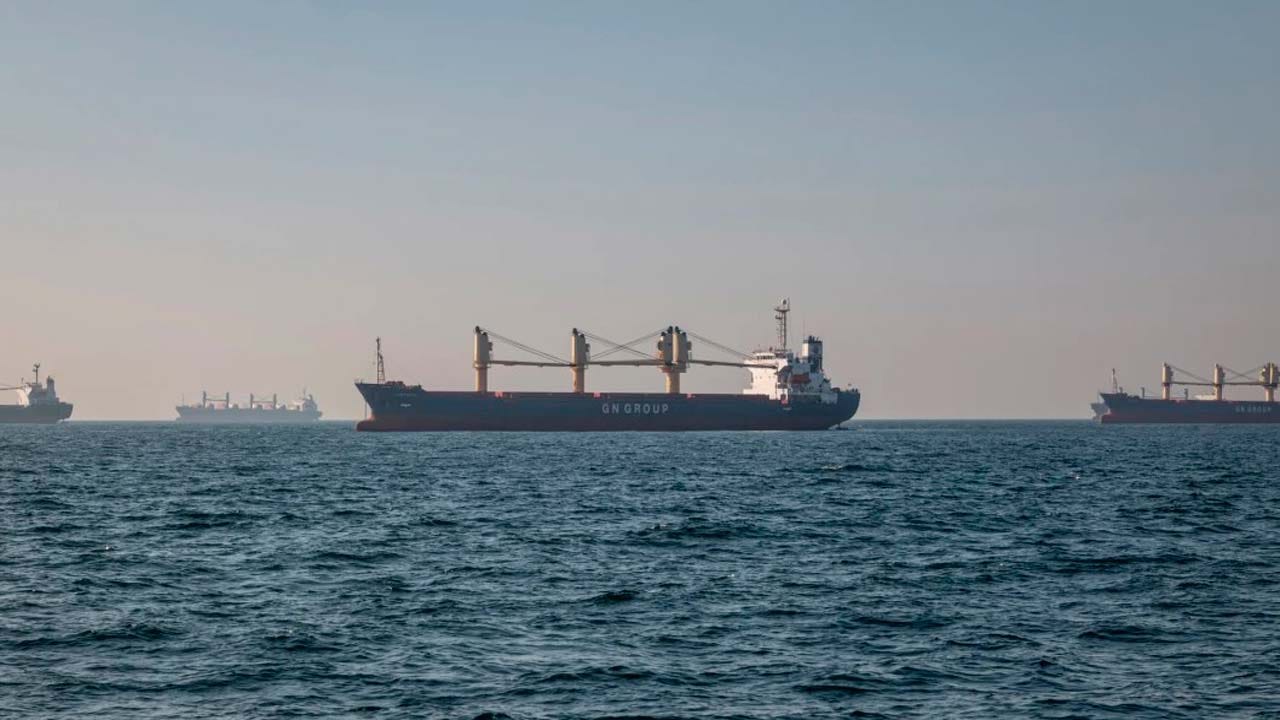
The Liberian-flagged bulk carrier Anna S was struck by five drones roughly 20 nautical miles off the Russian port of Novorossiysk while sailing empty toward the port to load grain. The vessel caught fire and was left, in the words of maritime security firm Vanguard Tech, “completely burned out.” All 21 crew members — 20 Filipino seafarers and a Romanian captain — abandoned ship and were rescued by a nearby bulker, the Malta-flagged Elina B.
The rescue did not end the danger. Roughly five hours later, the Elina B was itself struck by two drones, though it remained operational and continued toward a Turkish port despite the damage.
Not an isolated incident
The Anna S was the fifth vessel hit in a cluster of drone strikes against grain carriers near Novorossiysk and the nearby port of Tuapse over a 48-hour window. Among the other ships damaged were the Russian-flagged bulker Victoria V, struck while loading wheat at Novorossiysk; the Marshall Islands-flagged Fehu, hit shortly after departing the same port with a wheat cargo but able to continue its voyage; and the San Marino-flagged Necibe, damaged by drones at Tuapse while awaiting a wheat cargo. Together, the incidents mark the first confirmed wave of attacks specifically targeting grain carriers serving Russian Black Sea ports, rather than tankers or naval assets.
Russia’s Ministry of Defence, for its part, said it struck a separate dry cargo ship southeast of Odesa on the same day, alleging the vessel was carrying materiel for Ukraine’s armed forces — underscoring that both sides are now treating merchant shipping as a legitimate target set in this theater.
A fragile understanding under pressure
The timing is notable. In July, U.S. President Donald Trump had reportedly asked Ukrainian President Volodymyr Zelensky to halt strikes on ships near Novorossiysk specifically to avoid disrupting Kazakh oil exports moving through the Caspian Pipeline Consortium terminal, at a moment of tight global oil supply. That informal restraint appears to have broken down: a Suezmax tanker loaded with Russian oil was hit in the same waters less than 24 hours before the Anna S attack, suggesting a broader resumption of strikes against Novorossiysk-linked shipping rather than a one-off escalation.
For owners and charterers, the calculus is shifting fast. War-risk premiums for Black Sea calls, already elevated, are likely to move again — and this time the exposure extends beyond tankers into dry bulk, a segment that had operated with comparatively lower perceived risk in the corridor.
A second chokepoint under stress
The market impact is already visible upstream. USDA has cut its export forecasts for Ukrainian corn and wheat, citing the deteriorating security situation around Black Sea shipping lanes. That puts two of the world’s critical maritime chokepoints — the Strait of Hormuz and the Black Sea grain corridor — under simultaneous pressure, a combination the tanker and dry bulk markets have not had to price concurrently in recent memory.
What to watch now is whether insurers move to reclassify Novorossiysk-adjacent waters more broadly, which would ripple beyond the handful of owners currently trading there into freight rates for anyone still willing to call at Russian Black Sea ports.